The power of knowing how to work together
Mar 1, 2026
Nick Payne
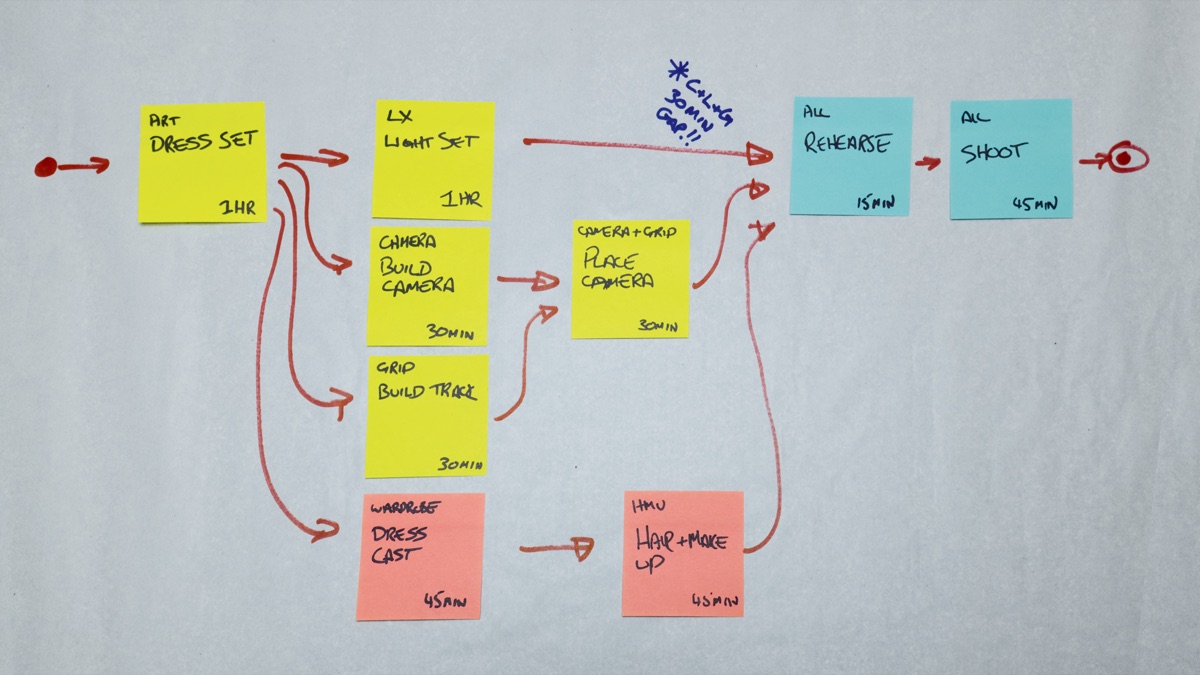
So many times new crews go on set together and they don’t actually know who each other is and how they are going to work together. The first few days are a mess as you work it out “on the fly”. Just having a conversation about this and agreeing the order of work will get your teams working better together immediately.
Here’s a method you can use to work out how your team meshes together with the other teams on set. You need the other heads of departments, a whiteboard, some post-it notes, and a couple of hours.
Get everyone to write down all the tasks that need to happen on set in order to start shooting a scene. Write one task per post-it note and then stick it on the whiteboard. Move the post-its into the order that the tasks need to be done. Some need to happen sequentially, and some can happen in parallel. Draw arrows between the notes to show the flow of work between each of the tasks. After that write on each post-it how long it takes (on average) to complete that task. (You might even write a range if the task varies a lot).
You now have a map of how work flows across the set.
Why is “flow” important?
Let me talk about desk jobs for a moment. Most companies are optimised for utilisation – or to use another word: busyness. When the CEO walks around the floor and sees someone not busy they freak out that money is being wasted on someone not doing anything. And so they create more work to give that person. The problem with this is when a job goes from one person to another the work has to wait until the other person is available to start it because they’re so busy! This is why corporations become so slow at getting stuff done. They’ve created efficiency at the expense of effectiveness.
Other organisations working with mission-critical activities optimise for availability. Think firefighters, paramedics, etc. You pay people to sit around so that when something happens they are immediately available to respond. This makes sense when the cost of that thing going wrong exceeds the cost of paying someone to do nothing.
In film we tend towards the availability end of this spectrum. Think of all the “standby” roles – props, wardrobe, etc. At the same time, as budgets get squeezed we’re being asked to have less people on set. This can make us too busy, rushed, and compromise the quality of what we shoot.
Could Toyota have an answer?
So how do you utilise your crew so that you aren’t rushed, deliver quality, and maintain availability? Believe it or not… Toyota might have the answer.
Toyota pioneered the “Toyota Production System”, which was a way of ensuring efficiency and effectiveness by optimising for “flow”. Think of the production line in one of their factories. A bunch of people each do a job one after the other to build a car as it flows along a production line. The secret of flow is that you design each job along that line to take roughly the same amount of time to complete. That way when a worker finishes their job, so does everyone else. And as the next car moves to them, they are able to start working on it straight away. By designing each job to be roughly the same size you eliminate the downtime of someone waiting because someone else is still working.
This is the calculation to make when deciding your crew: “how many people do I need so that my team takes the same amount of time as the other teams do?”
Going back to your “flow” map. You can now discuss with each other ways to improve the flow.
Are there any places where one team has finished and is waiting for another team? Could you speed up the other team by increasing its size? Should you slow down the first team by reducing their size? Are there sequential tasks that could be done in parallel? Are there tasks that could be done beforehand rather than on the day? Hint: blocking and rehearsing ahead of time saves money when you don’t have the whole crew waiting around watching.
You are a leader and manager – not only an artist
It’s easy to think about cinematography as the art of bringing lenses, camera movement, and lighting together to create an engaging, emotional experience for an audience. After all, we all got into this due to a love of cinema as an artform. But achieving this requires you to be a manager and a leader. Maybe more than you realise. And fundamental to this is the act of getting the work of your team to mesh smoothly with others.
Originally published in Australian Cinematographer Magazine issue 108, March 2026.
More Articles
Oct 5, 2026
Making great decisions fast
Dec 1, 2025
Having hard conversations
Sep 1, 2025
Using “intent” to lead a film crew
© 2019-26 Nick Payne